
When choosing LED lighting, selecting the appropriate color temperature is just as important as choosing brightness or wattage. Among all options, 5000K and 6000K are two of the most frequently compared daylight white lights. Both appear bright and clean, but they produce drastically different visual effects and are suitable for different applications. We will compare 6000K vs 5000K in terms of brightness, comfort, application scenarios, and real-world use cases to help you choose the best solution for your home, office, or commercial project. More details, pls read 2700K vs 3000K vs 4000K vs 5000K vs 6500K,How to Choose?
What Do 5000K and 6000K Represent In Lighting?
First, we need to know that the color temperature unit “K” comes from Kelvin and is used to describe the “warmth” or “coolness” of white light, not its brightness.
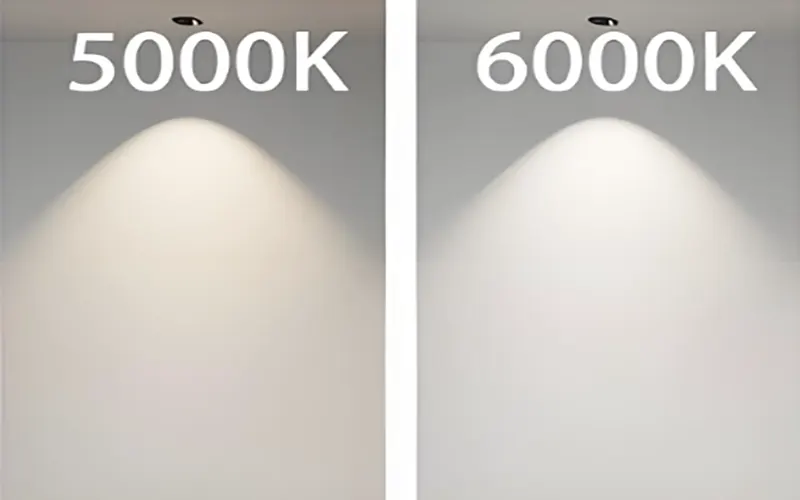
- 5000K: Known as “Natural Daylight,” it’s close to midday sunlight, making it a relatively natural and comfortable white light.
- 6000K: Known as “Cool White,” it has a bluish tint, is cooler, and has a sharper brightness.
Where is 5000K light used?
The advantage of 5000K light is its realistic color rendering, low eye irritation, and comfortable temperature even after prolonged exposure. 5000K is suitable for the following scenarios:
Home Lighting
- Kitchen main light, cabinet light
- Bathroom main light, vanity light
- Study, children’s room reading area
Commercial Display Lighting
- Jewelry display cases
- Cosmetic display cases
- Clothing stores
- Showroom display LED strip
Professional Lighting
- Photography
- Live streaming
- Product photography lights
Where is 6000K used?
The characteristics of a 6000K color temperature are that it appears very bright, visually sharp, and has a sobering effect. 6000K is used in places with specific characteristics.
Industrial Lighting
- Factory Workshops
- Production Lines
- Assembly Aisles
Warehousing and Logistics
- Warehouses
- Sorting Centers
- Logistics Aisles
Outdoor and Security
- Underground parking garage
- Fence lighting
- Surveillance lighting
- Street lighting
Which is brighter, 5000K vs 6000K?
This is a question everyone is concerned about, and also a typical misconception. From a brightness perspective, if two lamps have the same wattage and the same LED efficiency, they should theoretically be equally bright.
However, from the perspective of “human visual perception,” 6500K/6000K does appear brighter. This is mainly because cool white light has strong edge contrast, resulting in a stronger visual stimulus.
Is 5000K Light Harmful to the Eyes?
From an optical and medical perspective, it’s not color temperature that’s harmful to the eyes. In fact, 5000K itself doesn’t directly harm the eyes. What truly harms the eyes are severe flicker, poor blue light control, strong glare, and a low color rendering index.
In fact, 5000K is more soothing to the eyes, with a lower proportion of blue light than 6000K. It’s closer to the natural light spectrum, making it more naturally adapted to by the human eye. Therefore, 5000K is very suitable for long-term use.
Is 6000K Light Too Bright for a Living Room?
For most families, 6000K light is indeed too bright for a living room. Living rooms are typically 2700K-3000K, creating a warm, inviting space for gatherings. 6000K as main lighting in a living room usually results in a cool, harsh light.
6000K light has a high proportion of blue light, which can stimulate the central nervous system at night, making it difficult to relax. It’s best to choose a dual-colour temperature light for the living room that you can adjust to your needs.
5000K vs. 6000K: A Comparison of Common Scenarios
When choosing a color temperature, it’s crucial to understand the differences between 5000K and 6000K. Understanding their differences in visual physiology, color reproduction, spatial atmosphere, and functionality is paramount. Below, we break down the key dimensions in more detail and provide actionable conclusions.
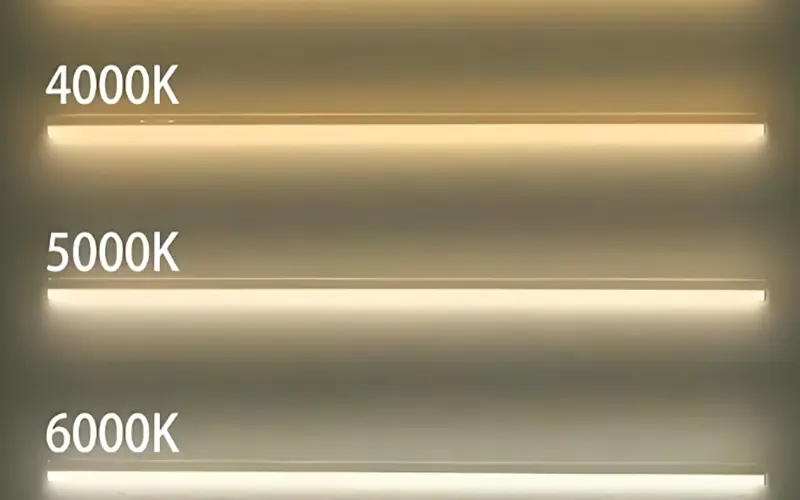
5000K vs 6000K: Eye Comfort
- 5000K: Relatively less short-wavelength blue light, its spectrum is closer to the peak of sunlight, and it interferes less with melatonin at night. It’s less irritating to the eyes and suitable for tasks requiring prolonged focus.
- 6000K: Increased short-wavelength blue light, resulting in improved visual sharpness, but it’s more likely to disrupt sleep rhythms at night. It provides noticeable stimulation, increasing alertness. However, prolonged exposure may cause dryness, fatigue, or discomfort.
For work and study involving prolonged close-range visual work, 5000K is the preferred choice. For high-intensity tasks or those requiring high contrast (inspection, security, workshops), 6000K is a better option.
At any color temperature, prioritizing flicker-free operation, a CRI ≥ 80 (recommended ≥ 90), and adequate light shielding is more important than simply looking at the “K value.”
5000K vs 6000K: Home Lighting
Home lighting is slightly more complex because it requires defining the function of each space to select the appropriate color temperature.
- 5000K: Living room (4000K–5000K recommended), 2700K–3000K is also an option, and a mixed color temperature is best. 5000K is also recommended for the kitchen, with 4000–5000K for main lighting, paired with dimmable or warm-toned auxiliary lights (such as floor lamps and wall lamps) to create depth. Avoid using a uniform 6000K throughout the house.
- 6000K: Suitable for bathrooms and garages, etc. 6000K provides stronger visual contrast, making it easier to identify tools and details. Choose glare-free fixtures with uniform light distribution and avoid strong direct light.
For main areas of the home, comfort is key; don’t just aim for “brighter” lighting. Therefore, we recommend using “tunable white” or “dimming + layered lighting” to meet the dual needs of working during the day and relaxing at night.
5000K vs 6000K: Office and Workspace Lighting
The preferences and reasons for different office/work types are as follows, which is also very important because it can improve employee motivation and sense of belonging.
- 5000K: Suitable for general office lighting, balancing productivity and employee comfort while reducing eye strain. Ideally, use evenly distributed diffused lighting paired with individual dimmable desk lamps.
- 6000K: 6000K is best chosen for production areas and laboratory/precision inspection areas. Use 6000K inspection lamps in specific areas while maintaining overall lighting comfort.
The best main lighting for office spaces is a combination of “controllable 5000K main light + 6000K task lighting”. For all long-term work areas, prioritize flicker-free drivers and appropriate color rendering index (CRI).
5000K vs 6000K: Commercial Lighting
- 5000K: For commercial applications (retail/supermarket/fresh produce), 5000K is better suited for showcasing the true colors of products, and can be used in conjunction with spotlights for accent lighting; CRI ≥ 90 is recommended.
- 6000K: 6000K is still recommended for workshops, production lines, and warehouses to improve operational efficiency and safety. High luminous efficacy (lm/W), good heat dissipation, and dust protection are also prioritized (IP rating depends on site requirements).
Retail and display applications prioritize “visual experience,” so 5000K + high CRI is preferred; while industrial and warehousing applications prioritize “functionality,” so 6000K + high contrast and uniform illuminance is preferred.
5000K vs 6000K: Outdoor Lighting
The color temperature of outdoor lighting is also very important, and its scope is quite broad. It includes architectural lighting, roadside lighting, and park lighting, among others.
- 5000K: 5000K is recommended for park landscaping and building facades. It appears natural at night, with good color reproduction, suitable for landscape lighting and showcasing the aesthetics of architecture. We can use warm white/natural white to highlight the texture of vegetation and exterior walls, avoiding an overly cool light that creates a “cold steel” feel.
- 6000K: 6000K is essential for parking lots/fences/security areas. It is more conducive to security camera recognition and pedestrian/vehicle safety identification. For stadiums/plazas, competitive events, and large-scale activities requiring high contrast and high-definition camera presentation, 6000K is more beneficial for television broadcasting and audience recognition.
6000K can be selected for security areas, but direct sunlight on residents’ windows should be avoided to reduce complaints. Another important point is that for public areas, priority should be given to ensuring uniform illumination and anti-glare design.
How to Choose Between 5000K vs 6000K?
Regarding this question, I think everyone has a clear understanding, whether it’s 5000K vs 6000K. Of course, you can also compare them from the following four aspects to see if the situations are the same.
Define the primary function of the space
- Is it primarily for people or hobbyists? → Prefer 5000K
- Prioritize work/efficiency/safety → Prefer 6000K
Determine Light Usage Duration
- Long-term tasks (≥ 2–3 hours/time) → Prioritize 5000K
- Short-term tasks (minutes to tens of minutes) → 6000K acceptable
Color Rendering Index (CRI) Requirements
- Product Display / Fresh Produce / Cosmetics → CRI ≥ 90 + 5000K (Recommended)
- Industrial Scenarios: CRI requirements can be relaxed, but a CRI of 80 or higher is still necessary, while ensuring color/label legibility.
Nighttime Use
- Avoid wide-area 6000K main light in home settings at night.
- Use adjustable LED strips or dimming systems (5000–6000K during the day, reduced to 2700–3500K at night).
Common Misconceptions When Choosing 5000K vs 6000K Lighting
Myth 1: Higher color temperature equals higher quality.
Color temperature only describes the color of light and does not represent quality or performance. Prioritize CRI, flicker, reliability, and light distribution.
Myth 2: 6000K is always more energy-efficient.
Power consumption and energy saving depend on luminaire efficiency (lm/W), not color temperature. At the same luminous flux, color temperature does not determine energy consumption.
Myth 3: The brighter the room, the better.
Excessive brightness or unsuitable color temperature will reduce comfort and cause eye strain. Layered lighting and dimmable lighting are recommended.
Myth 4: Ignoring CRI and flicker.
Low CRI causes color distortion, and flicker can cause headaches and eye fatigue—these have a greater impact on the experience than color temperature.
Myth 5: Mixing two types of daylight color in the same space.
Unless there is a clear zoning or deliberate design, two types of white light should never be mixed.
Summary
There is a difference between 5000K vs 6000K. 5000K is natural and comfortable, suitable for home use, while 6000K is bright and alert, suitable for industrial, warehousing, security, and other locations requiring short-term high contrast.
Want to balance daytime work and nighttime rest? Choose a Tunable White light strip, setting it to 5000–6000K during the day and dropping it to 2700–3500K at night.
FAQs
We need to know that brightness is primarily determined by “luminous flux/lumens,” not color temperature (K value). If the color temperature is 5000K and 6000K, but the power, LED efficiency, and luminous flux of two lamps are the same, their actual brightness is essentially the same.
5000K is more suitable for prolonged lighting, is gentler, and closer to natural light, thus promoting visual comfort and reducing eye fatigue. 6000K is not suitable for long-term use.
6000K is suitable for household lighting, including showers, living rooms, and garages. It’s best used in conjunction with a warm light source for functional lighting only, not as main lighting or for extended nighttime illumination.
No, color temperature and color rendering index (CRI) are two different concepts. A high color temperature (cool white) does not necessarily mean poor color rendering. If the luminaire’s CRI is high enough (e.g., CRI ≥ 80 or better ≥ 90), both 5000K and 6000K can reproduce object colors fairly realistically.