
In the LED strip market, LED strips come in many specifications. LED strips offer a variety of widths, lengths, and LED chip types, making them versatile for both residential and commercial lighting applications. The width of an LED strip is one of the most important parameters to consider when choosing one. Have you ever felt overwhelmed by the choice of the right LED strip size? Let’s take a closer look at the different width options to find the perfect strip for your lighting needs.
LED strips come in a wide variety of sizes and widths. There are mini LED strips with widths between 3-5mm, and standard widths of 8-10mm. In contrast, multi-row LED strips can reach widths of 12-22mm. Choosing the right LED strip width is crucial for ensuring good heat dissipation, flexible installation, and other factors. Furthermore, the size of the LED chip or SMD chip is another key factor affecting the width of the LED strip. More details, pls read How to Choose the LED Strip Lights Widths? Narrow LED Strip Vs. Wide LED Strip
What is the Standard Width of an LED Strip?
There isn’t actually a standard width for LED light strips. The most common width is 8-10mm, and that’s also the most in demand.
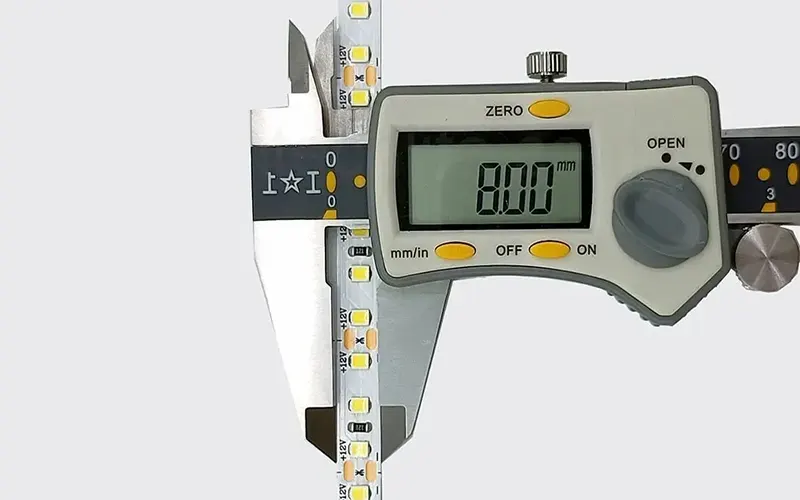
Let’s analyze the different widths. First, there are ultra-narrow LED light strips (3-5mm), commonly used LED light strips are 8-10mm wide, and there are also double-row strips (12-20mm). You can choose according to your needs.
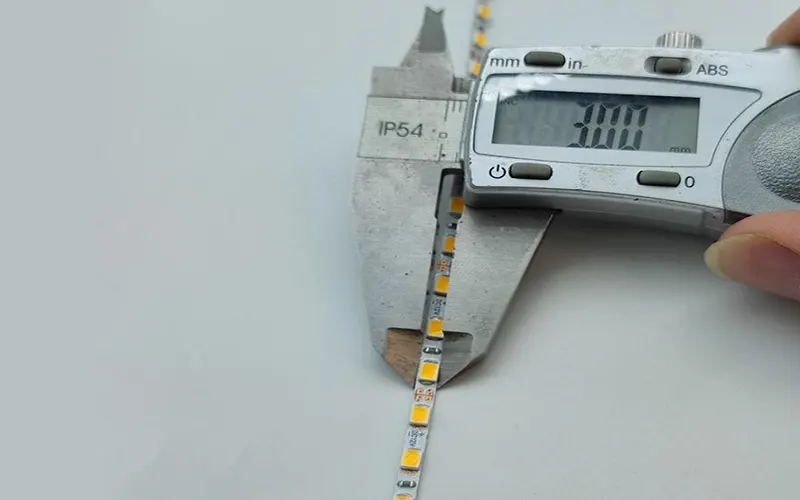
In fact, the width of an LED light strip is mainly determined by three factors: LED chip size, number of circuit lines, power, and heat dissipation requirements.
LED Chip Size (Determines Base Width)
Common Chip Models:
- 2835 → Narrow LED Strip (8mm / 10mm)
- 5050 → Wider (10mm / 12mm)
- COB → Evenly Covered (8–12mm)
Larger Chips → Wider LED Strip
Number of circuit traces (especially RGB/RGBW)
- Monochrome: 2 traces → Can be made very narrow
- RGB: 4 traces → Must be wider
- RGBW: 5 traces → Wider
More complex functions → Larger width
Power and Cooling Requirements
- High Power (>20W/m)
- Dual-row LEDs
Requires a wider PCB to accommodate thicker copper traces and improve heat dissipation.
What is the Thickness of an LED Strip in Millimeters?
Unlike width, LED strip thickness doesn’t have fixed “standard values,” but it does have a relatively stable range in the industry. For common SMD2835 or SMD5050 LED strips, a 1.5mm allowance is generally accepted.
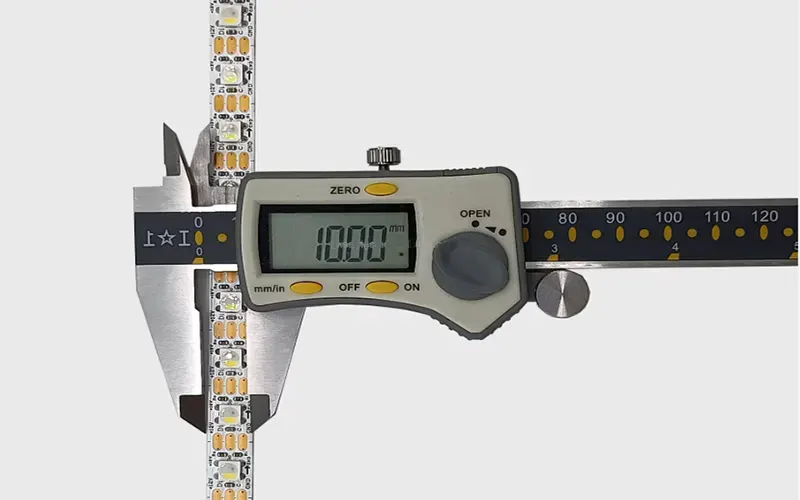
Generally, the thickness of non-waterproof LED strips is between 1.2mm and 1.8mm, with about 1.5mm being the most common. This thickness consists of two main parts: the PCB flexible circuit board itself (typically 0.8–1.2mm) and the height of the LED chips and solder joints (approximately 0.4–0.6mm).
When LED strips have a waterproof structure, the thickness increases significantly. For example, IP65 strips with surface epoxy resin are typically between 2.0–3.0mm; IP67 structures with tubing or extrusion molding generally reach 4–6mm in thickness; and fully potted IP68 strips can even reach 6–10mm in thickness. This is why many waterproof LED strips cannot be directly installed into ordinary aluminum profiles, requiring specialized, higher-space profiles or external mounting methods.
Different types of LED strips also vary slightly in thickness. For example, COB LED strips, due to their continuous fluorescent coating, are typically 1.6–2.2mm thick, slightly thicker than ordinary SMD LED strips. Multi-channel or IC-integrated strips like RGBW LED Strips or SPI LED Strips, with their more complex structures, are generally 1.5–2.2mm thick.
Essentially, the thickness of an LED strip depends primarily on three factors: PCB thickness, LED chip structure, and whether waterproofing is applied. A thicker PCB improves heat dissipation and stability but reduces flexibility; larger or more complex LED chips increase the overall height; and the waterproofing process, especially the tubing and potting compound, significantly increases thickness.
Why Should the Width of an LED Strip Be Considered?
When selecting or using LED strips, key factors directly affect installation, performance, and the final effect. First, the strip width determines whether it matches the aluminum profile or installation space. For example, common 8mm, 10mm, and 12mm strips require profiles with different inner groove dimensions.
If the strip is too wide, it won’t fit; if it’s too narrow, it may not be securely fixed or affect heat dissipation. Therefore, in actual projects, the strip width usually needs to be determined along with the profile dimensions. So, if you’re choosing LED profiles, you must pay attention to the LED strip width.
Second, the strip width affects circuit design and functionality. Different types of strips require different numbers of lines. For example, a single-color strip only needs two lines, while an RGB or RGBW LED strip requires more channels to control color changes. This requires a wider PCB to accommodate more lines and ensure stability.
Similarly, for RGB LED strips with integrated ICs, more space is needed to arrange the chips and signal lines, thus increasing the width. Furthermore, the strip width directly affects power handling and heat dissipation performance. Wider LED strips allow for wider copper foil traces, reducing voltage drop and making them suitable for high-power or long-distance power supply.
From a heat dissipation perspective, a wider PCB also means a larger heat dissipation area, which helps extend LED lifespan. Conversely, using overly narrow LED strips in high-power applications can easily lead to problems such as excessive heat generation, uneven brightness, and even shortened lifespan.
Do Wider LED Strip Lights Consume More Power?
Wider LED strips don’t necessarily consume more power. It’s important to understand that power consumption isn’t determined by the width itself, but by the power per meter (W/m) design.
However, in actual products, wider strips typically support higher power designs. This is because a wider PCB allows for wider copper traces, reducing resistance and voltage drop, while also providing better heat dissipation, allowing the strip to operate at higher currents.
For example, 10mm or 12mm strips commonly achieve power outputs of 14W/m, 20W/m, or even higher, while 8mm strips are typically found in low to medium power configurations (e.g., 9.6W/m, 12W/m). This leads many to the misconception that “wider strips consume more power.”
Furthermore, wider strips can often accommodate more or larger LED chips (e.g., SMD5050 LEDs compared to SMD2835 LEDs), thus increasing brightness output. In this case, the increased power is actually for higher brightness and better lighting effects, not simply because of the wider strip.
Does the Width of an LED Strip Lights Affect Cost?
The width of an LED light strip does affect cost, but it’s not the only determining factor. It indirectly impacts price through materials, structure, and performance design. However, a wider strip generally costs more.
Wider strips require larger flexible printed circuit boards (FPCBs), and wider, even thicker, copper foil, increasing raw material costs.
Secondly, width is often related to the strip’s functional complexity. Strips like RGBW or SPI LED strips require more circuit channels or IC chips, necessitating a wider design. This increases PCB costs and the cost of more electronic components (ICs, resistors, capacitors, etc.).
Thirdly, wider strips typically correspond to higher power designs. A wider structure allows for more LEDs or larger LEDs (e.g., SMD5050 LEDs compared to SMD2835 LEDs), increasing brightness. In this case, cost increases come not only from the width itself but also from the increased number of LEDs and higher power consumption.
Furthermore, width also affects accessory and installation costs. For example, wider light strips require larger aluminum profiles, diffusers, or connectors, and these accessories are usually more expensive. In engineering projects, this cost can sometimes be more significant than the price difference of the light strip itself.
How to Choose the Suitable LED Strip Width for Your Project?
The first consideration is the compatibility of the installation space and the mounting profile. This is the most basic yet most error-prone point. The selection criterion is that the width of the LED strip must be less than or equal to the size of the mounting groove (such as the inner groove of an aluminum profile); otherwise, installation is impossible.
Secondly, the width range needs to be determined based on the LED strip’s function. Different functions have different circuit space requirements. For example, monochrome LED strips have a simple structure and can be made narrower; while multi-channel or IC-integrated LED strips like RGBW LED Strips or SPI LED Strips require more circuitry or components, typically needing at least 10mm or even 12mm in width, or even wider. More information, pls read RGB LED Strip vs RGBW LED Strip?
Thirdly, brightness requirements and power design are crucial. If a high-brightness LED strip is needed, a wider PCB is required to handle greater current and provide better heat dissipation.
How to Choose the Right LED Profile For LED Strip?
Our generally accepted rule is that the inner width of the LED strip should be approximately 1-2mm wider than the strip width. For example, an 8mm LED strip typically uses a 10mm inner groove profile, and a 10mm strip uses a 12mm profile.
For cabinets, display cases, or extremely narrow structures, 8mm or even narrower LED strips are usually preferred; wider strips can be chosen for spaces with ample room.
When using waterproof LED strips with LED profiles, the width of the waterproofed LEDs must be the final consideration; otherwise, they will not fit.
Conclusion
Choosing the right LED strip width is one of the most important factors in any lighting project. When selecting, carefully consider the space, brightness, and application requirements. Each width offers a different function, from soft ambient lighting to large-area, high-intensity illumination. In every project, aesthetic or functional needs depend on the correct selection of the LED strip width: from a compact 8mm to wider widths, there’s always a solution to meet your needs.
No matter how wide your LED strip width your lighting project requires, Essenled is the ideal choice. We offer a wide range of SMD and COB LED strips to meet your diverse needs. Contact us today to get the LED strip width you require!
FAQs
There is no standard width, but several mainstream specifications have emerged in the industry. The most common are 8mm and 10mm, with 8mm being slightly more frequently used. Additionally, 12mm-15mm is common in RGB or RGBW LED strip lights.
Non-waterproof LED strips are generally between 1.2mm and 1.8mm thick, with about 1.5mm being the most common. Waterproof strips are thicker: IP65 is about 2–3mm, IP67 is about 4–6mm, and IP68 can even reach 6–10mm.
The width of the PCB board is basically the overall width of the LED strip, containing the LED chips, resistors, and circuit board. Common PCB widths are 3-5mm, 8mm, 10mm, 12mm, etc. Of course, widths greater than 12mm are for RGB or RGBW series.
No, the width of LED light strips varies greatly. Different types have different space requirements. For example, single-color light strips can be made narrower, while dual-color or multi-color LED light strips, with more complex circuitry or special structures, are usually wider.
Generally speaking, the width of LED light strips is usually between 5mm and 12mm, with 8mm, 10mm, and 12mm being the most common. If dual-color or multi-color applications are required, the width will be greater than 15mm.