
We all need a bright and comfortable office environment. This can improve work efficiency and also enhance employee mood and health. Office lighting is actually quite limited, and ceiling lights are one of the most common and practical office lighting fixtures. Whether in a traditional corporate office area or a home office space, choosing a suitable ceiling light can completely transform the work environment.
In this article, I will guide you through the basics of office lighting, the characteristics of ceiling lights, the differences in light color temperature, and the key points for selection from multiple perspectives, helping you make appropriate and practical ceiling light lighting decisions.
What is Office Lighting?
Office lighting refers to a lighting system that provides sufficient and comfortable light for office activities. Its main goal is to ensure people can see clearly, comfortably, and for extended periods, while enhancing a professional and pleasant atmosphere.
I believe an ideal and comfortable office lighting system should consider the following:
- Visual Comfort: Soft, uniform light without noticeable glare or shadows. It should make employees feel comfortable both while working and resting.
- Sufficient Brightness: Meeting the illumination requirements of different tasks such as work, writing, and computer operation.
- Energy Saving and Environmental Protection: Prioritizing the use of high-efficiency LED light sources to reduce energy consumption and maintenance costs.
- Harmony with Human Rhythms: The color temperature and brightness of the lighting should be coordinated with changes in natural light to reduce visual fatigue.
Office lighting generally includes general lighting, task lighting, and accent lighting. In fact, ceiling lights in offices are mostly used for general lighting, responsible for providing basic brightness to the entire space.
What Types of Lighting Can be used for Office Lighting?
Office lighting comes in many varieties, but it’s not advisable to install too many. In fact, it’s relatively simple, but different light fixtures have their own advantages in terms of function and aesthetics. Common types include:
1. Ceiling Light
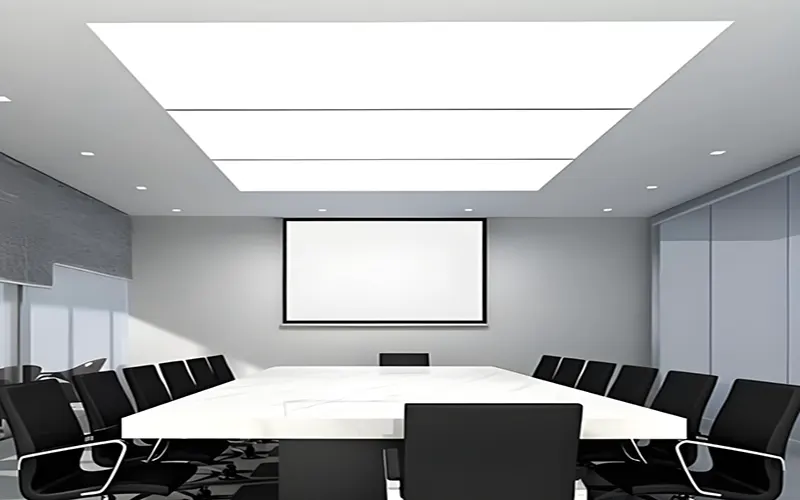
Ceiling lights are ubiquitous in various office types. Primarily installed on the ceiling, they provide even illumination and a clean, simple look, making them the most common main lighting fixture in offices. Suitable for meeting rooms, reception areas, and work areas.
2. Recessed Panel Lights (LED Panel Lights)
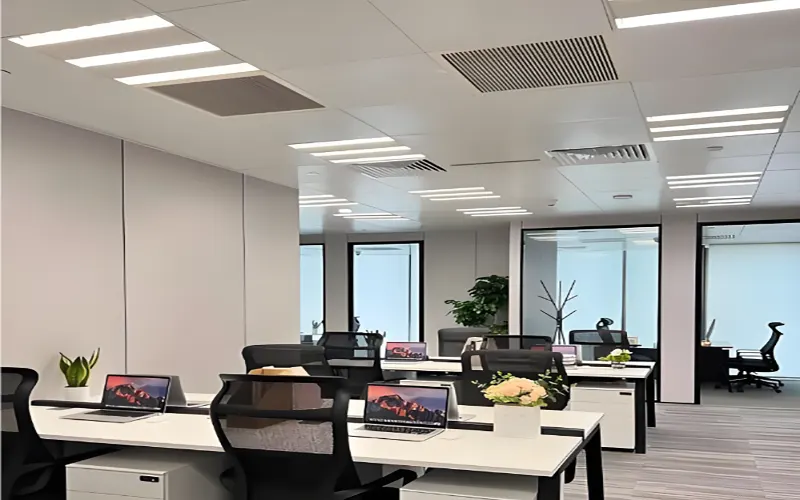
Recessed panel lights are also common in office lighting, mainly due to their simple appearance, thinness, large luminous surface, and uniform, soft light. They are typically used within ceiling grids and are a mainstream choice for modern office spaces.
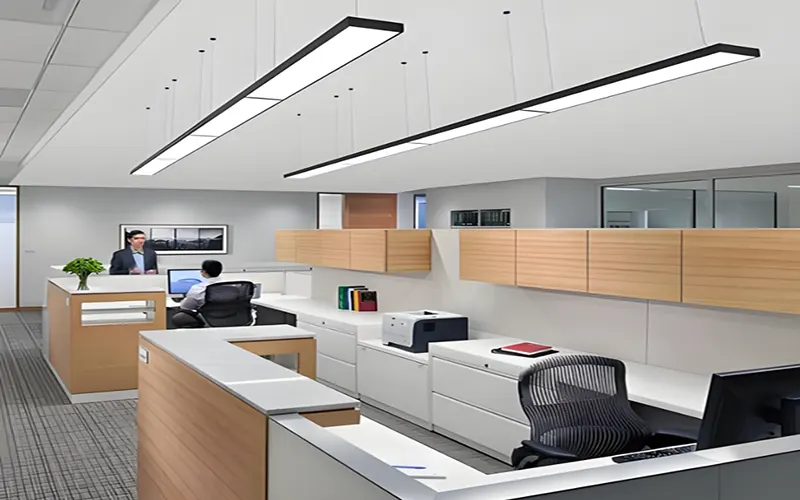
3. Linear Pendant Light
Pendant lights are often used in open-plan office areas or above conference tables, with a particular emphasis on conference tables. They combine decorative and practical functions. The light can be directed, providing more focused illumination.
4. Downlights & Spotlights
Downlights and spotlights are often used for localized lighting, such as on reception area logo walls, conference room display areas, or decorative walls, to create visual focal points. They are primarily used for ambient lighting.
5. Desk Lamps & Task Lamps
Desk lamps and task lamps provide adjustable lighting for individual work areas, facilitating detailed tasks and late-night work. They are used less frequently, but sometimes for decorative purposes.
What Kind of Ceiling Lights are Suitable for Office Lighting?
When choosing ceiling lights for offices, most people only focus on their appearance and price. However, it’s crucial to consider factors such as luminous efficacy, visual comfort, energy efficiency, lifespan, and intelligent control. A truly suitable ceiling light for office use should strike a good balance between performance and user experience. Here are some key features:
1. High Brightness and High Luminous Efficacy
Brightness is the most fundamental aspect of office lighting. The recommended illuminance for general office and meeting areas is 300–500 lux. It’s best to choose LED ceiling lights with a luminous efficacy of 90 lm/W or higher, which not only ensures sufficient lighting but also significantly saves energy.
High luminous efficacy means the luminaire can output more light with less electricity, effectively reducing operating costs in the long run, making it particularly suitable for offices that require prolonged illumination.
2. Anti-glare Design
When working in bright environments for extended periods, lighting fixtures must have a good anti-glare design. Otherwise, the light will directly irritate the eyes, causing visual fatigue, distraction, and even headaches.
It is recommended to choose lighting fixtures with anti-glare diffusers or anti-glare grilles, with a Uniform Glare Ratio (UGR) of less than 19 (UGR<19). This results in softer light and a more natural visual experience.
3. High Color Rendering Index (CRI ≥ 90)
The Color Rendering Index (CRI) determines the ability of light to reproduce colors accurately. For office environments, the CRI should be no less than 90 to ensure that colors on paper, documents, charts, and screens remain true to life.
4. Uniform Light Distribution
Offices require bright but not glaring lighting. Therefore, the light distribution of the lamps should be as uniform as possible.
High-quality LED ceiling lights typically use a light guide plate + diffuser plate design, which effectively diffuses light, making the brightness of the entire space balanced and consistent, without localized bright
5. Color Temperature is Crucial
Light color temperature directly affects mood and work efficiency. Neutral white light of 4000K–5000K is recommended for offices.
This neutral light color is neither as yellowish as warm light, which promotes relaxation, nor as cold as cool white light, but rather falls in between, closer to natural light.
It helps employees stay alert and focused while creating a refreshing work atmosphere, making it the most balanced choice for the office.
6. Energy Saving and Long Lifespan
LED ceiling lights typically have a lifespan of 30,000–50,000 hours, far exceeding that of traditional fluorescent or incandescent bulbs. High-quality lights also feature low light decay, with minimal brightness reduction even after prolonged use, providing consistently stable lighting.
7. Intelligent Control Integration
Modern office spaces increasingly emphasize intelligent and energy-efficient management. Intelligent ceiling lights with functions such as dimming and color temperature adjustment, human body sensing, timer switching, and sunlight sensing can automatically adjust brightness based on natural light intensity or human activity.
These types of lights are not only energy-efficient and environmentally friendly, but also enhance lighting comfort and the office experience. For example, a soft mode can be switched during meetings, while brightness can be automatically increased when working overtime at night, balancing practicality and flexibility.
3000K vs. 4000K Ceiling Lights: Which is Better for a Home Office?
Many people struggle with the choice between 3000K and 4000K color temperatures when setting up a home office. More details, pls check What Is The Ideal Color Temperature for Office Lighting?
The main difference between these two color temperatures lies in the ambient light:
- 3000K (Warm White): The light has a yellowish tint, creating a warm and relaxing atmosphere, suitable for the overall home environment.
- 4000K (Neutral White): The light is clear and natural, closer to sunlight, suitable for focused work and extended periods of time.
For a home office, we believe 4000K is the more ideal choice. It maintains clear visibility while ensuring comfort, helping to improve focus. If the work area and rest area are combined, an adjustable color temperature ceiling light (2700K–6500K) can be chosen, allowing for smart control to switch between different scenarios.
Which Ceiling Light Color is Best for Office Lighting?
Light color affects mood and concentration. Studies show that different color temperatures elicit different brain responses. Most people still choose 4000K-6000K for ceiling lighting, but we believe 6000K is too bright and can strain the eyes.
Therefore, neutral light around 4000K is most recommended for office lighting. It maintains clear vision without creating a cold or glaring feeling, making it an ideal choice that balances efficiency and comfort.
Should All Office Lighting Be Cool White Light Only?
Not necessarily. While we recommend neutral white light for ceiling lights in offices, a blend of warm light is still necessary for employee relaxation time. This also depends on the purpose and atmosphere of the workspace.
- Cool white light (4000K–5000K) creates a vibrant and invigorating atmosphere, ideal for fast-paced offices or design studios.
- Warm white light (2700–3500K) provides a relaxed and comfortable feel, more suitable for lounges or meeting areas.
For more flexible color temperature adjustment, I think you could consider using an adjustable color temperature lighting system. Users can adjust the color temperature at different times of the day as needed—cooler in the morning for increased productivity, and warmer in the evening for a more relaxing atmosphere.
How to Choose the Right Ceiling Light for Your Office?
When choosing a ceiling light for your office, after understanding luminous efficacy, color temperature, and lumens, we can summarize the key steps for selecting an office ceiling light:
- Define Your Lighting Needs
First, establish a basic tone and determine the type of space your office is: open-plan workspace, meeting room, reception area, or a home office corner. Different areas have different illuminance and style requirements.
- Choose the Right Size and Shape
Round ceiling lights are suitable for smaller spaces, while rectangular panel lights are more suitable for spacious office areas. It is recommended to install one main light per 10–15 square meters, or use a multi-light distribution method.
- Prioritize Light Quality
Prioritize branded lighting fixtures with high color rendering, high luminous efficacy, and low glare to avoid light decay or flickering problems caused by cheap products. Poor quality fixtures will result in higher repair costs later, and will be time-consuming and laborious.
- Consider Smart Control
Modern offices generally include smart control boxes. In fact, ceiling lights with dimming, color temperature adjustment, or human body sensing can make lighting more user-friendly and energy-efficient.
Summary
Office ceiling lights are more than just illumination; they directly impact employee comfort, focus, and overall work efficiency. When choosing a ceiling light, brightness, color temperature, luminous efficacy, anti-glare design, and space requirements should be considered comprehensively.
Overall, 4000K neutral white LED ceiling lights with a CRI ≥ 90 are ideal for offices. For home office workers, adjustable color temperature models are a good option, allowing for easy switching between work and rest lighting atmospheres.
FAQs
For office spaces, LED panel lights, ceiling lights, and linear lights are the most common and effective choices. LED panel lights are primarily suitable for open-plan offices and meeting rooms, providing uniform and glare-free lighting.
Ceiling lights offer a modern, non-main-light design. Their ease of installation makes them ideal for offices without suspended ceilings. Linear pendant lights or recessed fixtures are stylish and provide directional lighting, suitable for workstations or meeting tables.
Office lighting brightness depends on the size and function of the room. You can refer to these figures: General office areas: 300–500 lux, Meeting rooms: 400–600 lux, Final design and work areas: 700 lux or higher.
4000K neutral white light is generally the best choice for offices. It produces clean, natural light, keeping employees alert without being glaring. While 3000K warm white light is comforting, it’s unsuitable for office use; it doesn’t keep people alert and is only suitable for home lighting.
The number of ceiling lights depends on the room size, ceiling height, and the brightness of each light. We can choose according to the following standards: For standard 24W-36W LED panel lights, one light is needed for every 10-15 square meters.
This is a good question. To reduce glare in office lighting, choose luminaires with a UGR value less than 19 (Uniform Glare Rating)—this ensures visual comfort while working on a computer. Choose diffused or frosted lampshades, recessed designs, and wide beam angles to soften the light.