
LED strip lights have become one of the most common and stylish lighting solutions in modern homes. From highlighting architectural details to creating a warm atmosphere, they are ubiquitous. However, many users find after installation that the light strips are exposed, the power supply is visible, and the light is glaring, severely impacting the overall effect. Therefore, if you want to create a stylish and professional home décor, learning how to hide LED strip lights and LED power supplies is crucial.
Proper concealment not only enhances aesthetics but also protects the light strips from dust and accidental damage, thus extending their lifespan. Let’s explore some effective concealment techniques to create a seamless visual effect.
Should LED Strip Lights Be Visible?
For small home lighting projects or projects with obstructions like ceilings, LED strips can be left exposed.
However, from a professional perspective, most LED strips should not be directly exposed to the line of sight. Ideally, lighting should be achieved through reflection or diffusion, allowing light to naturally diffuse rather than making individual LED beads visible. This design is often called “indirect LED lighting” and is widely used in residential, hotel, and commercial spaces.
When LED strips are directly visible, they can create noticeable LED dots, affecting the overall aesthetics and causing glare, reducing the comfort of the space. Especially in bedrooms or living rooms, exposed strips can look cheap and out of place.
Why is Hide LED Strip Lights Crucial?
Hide LED strip lights is not just a visual optimization, but a key step in improving overall lighting quality. First, from a spatial aesthetic perspective, concealing the light source creates a cleaner, more streamlined environment.
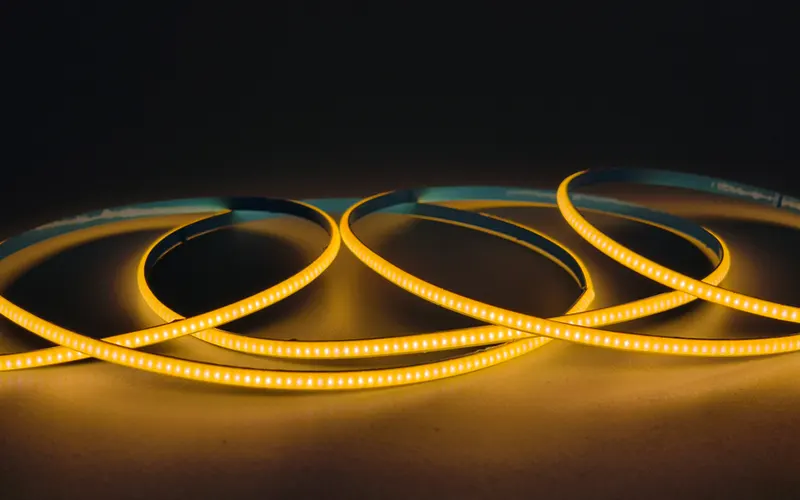
Minimalist Design Style
It aligns with the current trend of minimalist lighting design. Without cluttered light fixtures and wiring, the space appears more sophisticated.
Reduce Glare
Secondly, concealed LED strips effectively reduce glare. When the light source is blocked or diffused, the light becomes softer and more uniform, making it more suitable for prolonged use. This is especially important in office and home environments.
Light Uniformity
Furthermore, concealed installation can improve light uniformity. Through reflection from walls, ceilings, or light troughs, LED strips can form a continuous band of light instead of point light sources, thus achieving a more natural lighting effect (diffused LED lighting).
How to Choose the Right LED Strip for Easy Concealment?
Before delving into techniques for hide LED strip lights, the first step is choosing the right one. Certain models are easier to hide due to their design.
Ultra-thin LED Strips: These strips are thinner, such as 3mm/4mm and 5mm COB LED strips, making them easier to conceal in confined spaces.
Flexible LED strips: While ordinary LED strips are bendable, flexible LED strips are also available. S-plate LED strips are ideal for curved surfaces or complex furniture designs.
Pre-diffused LED strips: These strips have built-in diffuser grooves that evenly distribute light, minimizing glare when hidden behind edges.
How to Cleverly Hide LED Strip Lights in Different Spaces?
The choice of LED strip is crucial for achieving a truly ideal concealment effect. Different types of LED strips vary greatly in their final appearance. High-density LED strips are the best choice, and LED profiles can be used if needed.
Under Cabinets
Kitchen countertops are a popular location for installing LED strip lights, while ensuring adequate brightness. To better conceal them:
- Install the strip lights along the edges of cabinets or within aluminum channels.
- Use diffusers to prevent noticeable glare.
- Route the wiring along the edges of the cabinets and secure it with adhesive clips.
Behind TVs and Monitors
This is used for creating ambient backlighting and is typically fixed with 3M adhesive:
- Install LED light strips behind the screen edge.
- Conceal wiring in cable management conduits or wall-mounted cable trays.
- Ensure the light strips do not extend beyond the screen edge for a professional and aesthetically pleasing look.
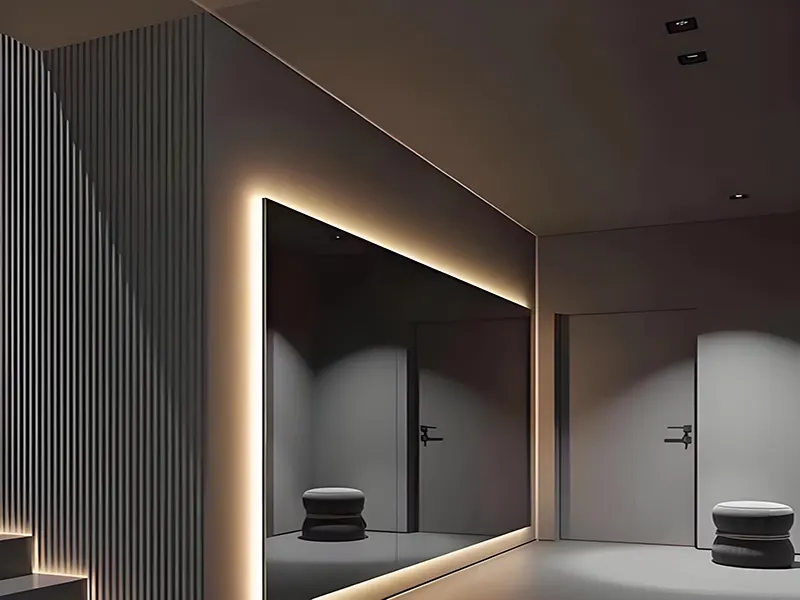
Ceilings and Cornices
Ceiling lighting is one of the most luxurious applications and a common choice for home lighting.
- Hide LED strip lights within cornice trim to diffuse light upwards.
- Ensure power cords run through walls or are concealed within conduits.
- Use warm white or RGB lighting to create a personalized ambiance.
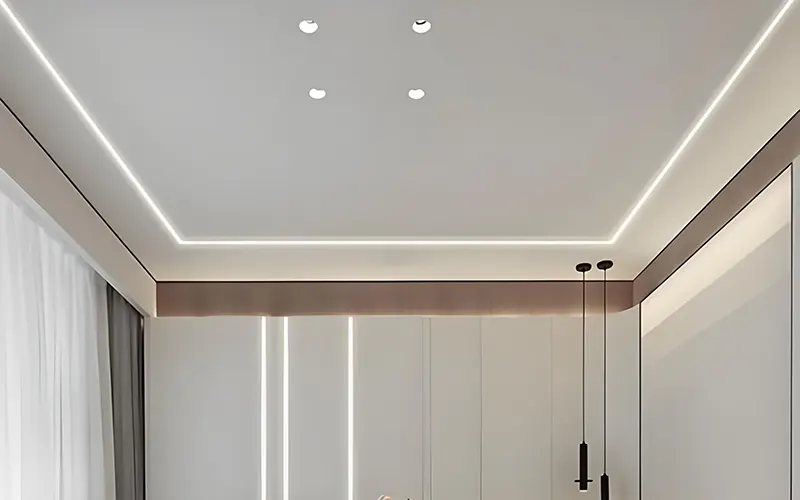
Staircases and Hallways
Innovative lighting technology allows you to illuminate and decorate staircases and hallways with LED light strips. It significantly improves safety.
- Illuminate the edges of stairs for enhanced safety and aesthetics.
- Install light strips under each step or on the handrail.
- Use aluminum channels to conceal the light strips, avoiding direct visibility.
- Hide wiring behind the baseboard.
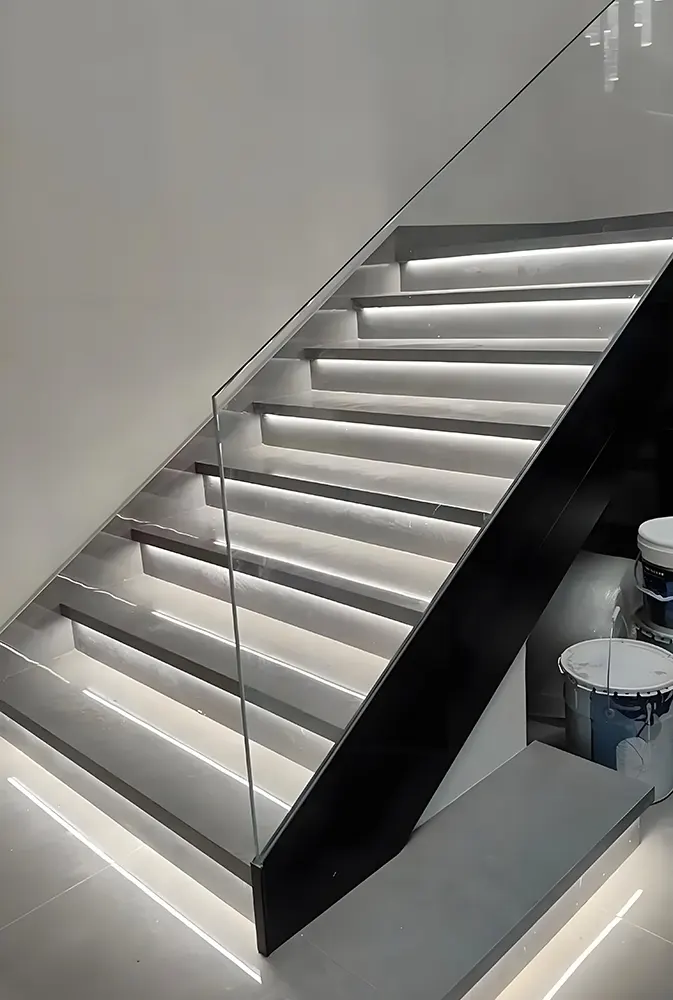
Furniture and Bed Frames
LED light strips can be perfectly concealed in wardrobes and on furniture, enhancing the overall sense of sophistication.
- LED light strips can transform furniture into eye-catching decorative pieces.
- Install them under sofas, headboards, or dressing tables.
- Hide the light strips in recesses or behind decorative trim.
- Conceal the power module behind the furniture for a wireless look.
How to Conceal Power Supply Without Compromising Safety?
Safety is paramount when concealing LED power supplies. Many users, in pursuit of ultimate concealment, completely enclose the power supply within walls or ceilings. This is actually extremely dangerous. Ideally, LED power supplies should be installed in well-ventilated areas.
The correct approach is to ensure visual neatness while providing sufficient space for heat dissipation and avoiding direct contact between the power supply and flammable materials. Furthermore, a suitable power supply should be selected based on the LED strip’s wattage to avoid prolonged overload operation.
Using certified power supplies (such as those with UL or CE certification) is also crucial, as it relates not only to product quality but also to long-term stability.
Common Mistakes to Avoid When Hide LED Strip Lights
In real-world projects, some common mistakes are quite prevalent. For example, using low-density LED strips can lead to noticeable spotlight issues, or failing to use a diffuser can make the light too harsh. These problems directly impact the final result.
- Installing the LED strip too close to the edge: This causes the light source to be directly exposed instead of creating a soft halo.
- Not using a diffuser: Using low-density LED strips results in noticeable spotlights, or the lack of a diffuser makes the light too harsh. These issues directly affect the final effect.
- Ignoring power supply concealment: Even if the LED strip is neatly installed, it will still look cluttered if the power adapter is suspended in the air.
- Overusing adhesive without cleaning the surface: Dust weakens the adhesive’s adhesion, causing the LED strip to detach.
- Ignoring heat dissipation: hide LED strips without ventilation may overheat and damage prematurely.
Conclusion
Hide LED strip lights and power supplies is not a single step, but a systematic project. From initial design and product selection to installation, every step affects the final result.
When the light strips are perfectly hidden, the power supply is invisible, and the light is soft and even, the entire space presents a natural, comfortable, and sophisticated atmosphere. This is precisely the “seamless LED lighting” that modern lighting design strives for. If you need a narrow LED tape series, don’t hesitate to get in touch with us.
FAQs
LED strip lights typically operate on low voltage (e.g., 12V or 24V), while household electricity is usually high-voltage AC (110V/220V). Therefore, a power adapter (LED driver) is necessary for conversion; otherwise, the light strip will not function properly and may even be damaged.
We do not recommend this, as the power supply needs space for heat dissipation and maintenance. If completely sealed, it is prone to overheating and even damage. We suggest using an openable access panel or ventilation space for concealment.
There are many reasons for this, the most common being insufficient or mismatched power supply. For example, insufficient wattage or inconsistent voltage can cause flickering, uneven brightness, or even partial blackouts.
Generally, it’s not recommended. Exposed LED strip lights are prone to glare and noticeable light spots, affecting aesthetics. Hidden LED strip lighting provides a softer, more even light effect.
Normally, it is safe. LED light strips have low power consumption and generate little heat, so they can generally be used for extended periods. However, this is contingent on a reliable power supply, proper installation, and a good heat dissipation environment.